EPGC 201 vs G10: Complete Guide to G10, FR4, G11 Epoxy sheets
EPGC 201 and G10 are essentially the same industrial rigid laminate sheet. Their relationship is like "two names for one product," with differences in nomenclature arising solel...
EPGC 201 and G10 Epoxy Laminate Sheets
EPGC 201 and G10 are essentially the same industrial rigid laminate sheet. Their relationship is like “two names for one product,” with differences in nomenclature arising solely from regional and industrial standard systems.
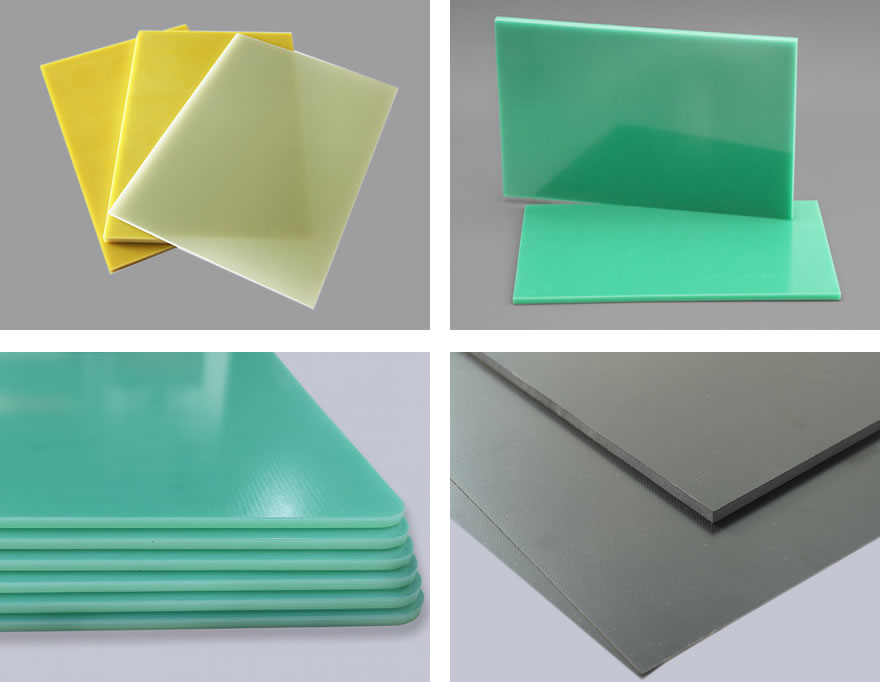
What is EPGC 201?
EPGC 201 (Full Name: Epoxy Glass Cloth Reinforced Laminate) is a high-performance rigid insulating material specifically engineered for the electrical, power, and electronics industries.
It is manufactured by impregnating multiple layers of alkali-free fiberglass cloth (as the reinforcement) with a high-molecular epoxy resin matrix, which is then baked, pressed, and cured under high temperature and high pressure.
Nomenclature & Standard Interpretation of EPGC 201
In international industrial standards, EPGC 201 has several “synonyms.” Its naming directly reflects its core composition:
EP (Epoxy):Epoxy resin matrix.
GC (Glass Cloth):Fiberglass cloth reinforcement.
201:The specific heat-resistant, non-flame-retardant grade code under the IEC 60893-3-2 standard (International Electrotechnical Commission).
The Relationship Between EPGC 201 and G10
EPGC 201 and G10 are identical in material substance, varying only by national and industrial standard designations. They serve as equivalent grades to one another:
Standard Naming Differences:
EPGC 201:Governed by IEC and DIN (German National Standard) systems.
G10:Governed by the NEMA (National Electrical Manufacturers Association, USA) standard.
Identical Performance:Their physical characteristics—including mechanical strength, electrical insulation properties, thermal resistance (typically Class B, 130°C), and low water absorption—are fully aligned.
Interchangeability:In practical industrial production and engineering applications, these two grades are completely interchangeable.
Core Features of EPGC 201 / G10
High Mechanical Strength:Exhibits exceptionally high flexural, shear, and tensile strength at both ambient and elevated temperatures.
Excellent Electrical Properties:Maintains high dielectric strength and insulation resistance even under high-humidity or damp conditions.
Superior Thermal and Moisture Resistance:Features extremely low water absorption, allowing reliable operation in harsh industrial environments.
Excellent Machinability:Highly suitable for various mechanical processes, including turning, milling, drilling, and precision CNC routing.
Selection Guide for Epoxy Fiberglass Cloth Laminated Sheets
In practical industrial applications, G10 / EPGC 201 offers excellent overall performance, but it is not suitable for every application. During material selection, it is necessary to compare it with commonly used alternatives such as FR4 (EPGC 202), G11 (EPGC 203), and traditional Chinese 3240 to determine the most suitable solution.
Material Selection Comparison Table
| Material (NEMA Grade) | IEC Equivalent Grade | Key Differences Compared with G10 | Flame Retardancy (UL 94) | Thermal Class (Tg / Temperature Rating) | Recommended Applications |
| G10 | EPGC 201 | Standard basic grade. Features high mechanical strength and excellent electrical insulation performance. Non-flame-retardant grade. | HB (Non-flame-retardant) | Class B (130°C) | Heavy-duty motors, transformers, electrical insulation components, and mechanical structural parts without strict fire protection requirements. |
| FR4 | EPGC 202 | Flame-retardant version of G10. Mechanical and electrical properties are basically equivalent to G10, but with improved fire resistance. | V-0 (Self-extinguishing after removal of flame) | Class B (130°C) | PCB drilling backup boards, EV battery insulation sheets, and electrical switchgear requiring strict flame-retardant performance. |
| G11 | EPGC 203 | High-temperature upgraded version. Maintains more than 25% of mechanical strength at 150°C operating temperature. | HB / Depends on formulation | Class F (155°C–180°C) | High-power F/H class motors, high-temperature industrial equipment, metallurgy insulation components, and tooling fixtures. |
| 3240 | — | Economical alternative based on Chinese national standards. Slightly lower performance than G10, with larger thickness tolerance, but more cost-effective. | Non-flame-retardant | Class B (130°C) | Cost-sensitive applications, general insulation spacers, and applications without strict dimensional accuracy requirements. |
Common Machining Defects and Solutions (Avoiding Common Problems)
| Common Machining Issue | Cause Analysis | Practical Solutions |
| Edge fuzzing and burrs | Tool wear; conventional single-flute or double-flute cutters cannot effectively cut through the glass fibers. | 1. Replace with a new cutting tool. 2. Use tungsten carbide corn milling cutters. 3. Apply climb milling (down milling) method. |
| Interlayer delamination and edge chipping | Excessive cutting force caused by aggressive feed rates; workpiece bottom not properly supported during drilling. | 1. Use a backing plate during drilling. 2. Reduce feed per tooth and machine in multiple passes. 3. Select tools with proper helix angles to direct cutting forces downward. |
| Tool discoloration and material burning | Excessive local cutting temperature; cutting tool remains stationary too long during machining. | 1. Increase feed speed to reduce tool dwell time. 2. Improve dust extraction airflow or use air cooling. |
| Oversized dimensions / undersized holes | Epoxy laminate has slight elastic recovery, and machining heat may cause minor thermal expansion. | 1. Adjust tool diameter compensation by increasing drill or milling tool size by 0.02–0.05 mm compared with the theoretical drawing dimension. |
Consult the manufacturer
If you are looking for EPGC201/G10 epoxy fiberglass sheets or precision-machined insulation parts, please contact Xujue Electrical.
Xujue Electrical is a professional manufacturer of electrical insulation materials with over 65 years of experience, specializing in the research, development, production, and precision machining of high-performance insulation materials. Our products are widely used in power transformers, motors, new energy, electronics, communication equipment, medium and high voltage power transmission and distribution equipment, rail transportation, and industrial insulation processing.
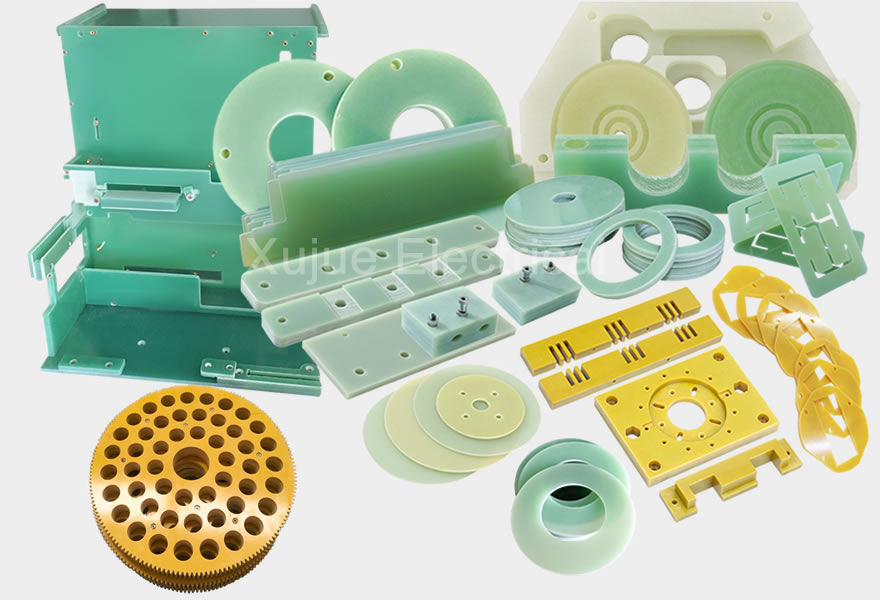
With mature production processes and advanced CNC machining capabilities, we can customize EPGC201/G10/G11/FR4 epoxy sheets and insulation parts of various specifications, thicknesses, tolerances, and complex structures according to customer-provided drawings, samples, or technical requirements to meet the high-precision needs of different application scenarios.
Leave us a message to get quotation and sample!
If you are interested in our products,, please send us a message and we will contact you as soon as we receive it. Email: info@ztaero.com whatsApp: +8616650273778
Releated News
- 10-26 2026Transformer Crepe Paper Specifications and Selection Guide
- 10-23 2026G10, FR4 & G11 Epoxy Sheets: Standard Sizes & Max Thickness
- 10-22 2026Epoxy Fiberglass Winding Tubes in Composite-Housed Metal Oxide Surge Arresters
- 10-20 2026FR4 Insulation Barriers: Applications in Electrical Equipment
- 10-16 2026Epoxy Fiberglass Laminates in Europe: Trends & Applications
- 10-13 2026How to Choose DDP Insulation Paper for Oil-Immersed Transformers?