FR4 Insulation Barriers: Applications in Electrical Equipment
FR4 insulation barrier applications in switchgear, busbar systems and electrical cabinets. Custom CNC machining available to meet equipment requirements.
FR4 Epoxy Insulation Barriers
FR4 epoxy insulation barriers are electrical insulation components manufactured from flame-retardant epoxy glass fiber laminated sheet. They are primarily used in switchgear, power distribution equipment, busbar systems, and certain industrial electrical applications to provide electrical isolation, insulation protection, structural separation, and auxiliary mechanical support.
FR4 insulation barriers can be custom CNC-machined according to customer drawings. Available processes include cutting, drilling, slot milling, notching, and custom-profile machining.
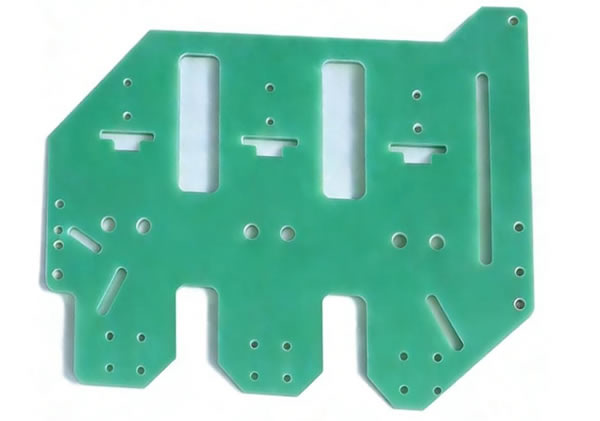
1. Product Appearance and Common Configurations
Common product configurations include:
- Flat Insulation Barriers: Used to provide electrical separation between components.
- Drilled Insulation Barriers: Machined with mounting holes and bolt holes according to installation requirements.
- Slotted Insulation Barriers: Designed with slots or cutouts to accommodate busbars, conductors, or equipment structures.
- Custom-Shaped Insulation Barriers: Manufactured with profiles tailored to the internal structure of specific electrical equipment.
- Multi-Layer or Modular Barriers: Designed for assembly and installation according to equipment specifications.
The actual structure, thickness, and color of each barrier should be determined by the customer’s drawings and the specified material grade. The insulation rating cannot be determined from appearance alone.
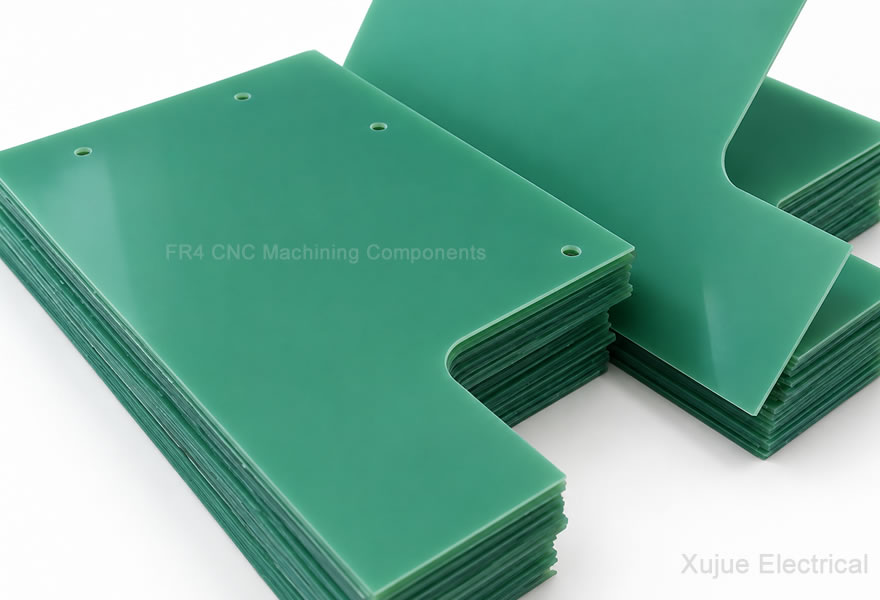
2. Main Applications of FR4 Insulation Barriers
2.1 Phase Barriers for Switchgear
Phase barriers are installed between conductors of different phases or adjacent electrical compartments to help maintain the required insulation clearances and reduce the risk of accidental contact.
They are used in certain low-voltage and medium-voltage switchgear applications. The suitability of the material and barrier design must be verified against the equipment’s electrical and mechanical requirements.
2.2 Busbar Insulation Barriers
In busbar systems, FR4 barriers serve as insulating partitions or protective barriers. Holes, slots, and edge profiles can be CNC-machined to match the busbar layout.
Key design considerations include phase-to-phase clearance, phase-to-ground clearance, creepage distance, and mechanical forces that may occur during short-circuit conditions.
2.3 Electrical Cabinet Partitions
FR4 partitions are used for internal separation and insulation in control cabinets, distribution boxes, and industrial electrical equipment.
They can be custom-cut and CNC-machined to fit the available installation space and the structural requirements of the equipment.
3. FR4 Insulation Barriers vs. G10 Epoxy Glass Laminate
| Comparison Item | FR4 Insulation Barriers | G10 Epoxy Glass Laminate Components |
|---|---|---|
| Product Focus | Applications with specific flame-retardancy requirements | Applications emphasizing mechanical strength and electrical insulation |
| Material Composition | Epoxy resin reinforced with woven glass fabric | Epoxy resin reinforced with woven glass fabric |
| Flame Retardancy | Manufactured with a flame-retardant formulation; the actual rating depends on the material grade and applicable certification | Standard G10 does not automatically meet the UL 94 V-0 flame-retardancy classification |
| Main Applications | Electrical equipment requiring a specified level of flame retardancy | Structural insulation applications that do not require a specific flame-retardancy classification |
| Mechanical Properties | Good mechanical strength | Good mechanical strength |
| Electrical Insulation | Good electrical insulation properties | Good electrical insulation properties |
| CNC Machining Capabilities | Drilling, slot milling, cutting, and custom-profile machining | Drilling, slot milling, cutting, and custom-profile machining |
| Typical Products | Switchgear insulation barriers, busbar barriers, and phase barriers | Insulating support plates, spacers, mounting plates, and custom structural components |
| Key Selection Factors | Flame-retardancy rating, electrical performance, operating environment, and equipment requirements | Mechanical strength, electrical performance, dimensional accuracy, and operating environment |
The basic material structure and mechanical and electrical properties of FR4 and G10 can be very similar. The key difference is generally the flame-retardant formulation and the corresponding certification requirements.
FR4 and G10 should not be distinguished solely by their names or appearance. The appropriate material grade should be selected according to the required flame-retardancy classification, electrical insulation performance, mechanical requirements, and applicable equipment standards.
Leave us a message to get quotation and sample!
If you are interested in our products,, please send us a message and we will contact you as soon as we receive it. Email: info@ztaero.com whatsApp: +8616650273778
Releated News
- 10-20 2026FR4 Insulation Barriers: Applications in Electrical Equipment
- 10-16 2026Epoxy Fiberglass Laminates in Europe: Trends & Applications
- 10-13 2026How to Choose DDP Insulation Paper for Oil-Immersed Transformers?
- 10-12 2026FR4 Epoxy Fiberglass Sheets for CNC Machining Factories
- 10-10 2026Transformer Pressboard
- 10-09 2026Epoxy Fiberglass Filament-Wound Tubes for Transformer Core Winding Insulation