G7 Silicone Fiberglass Laminate Sheet | Selection Guide & Manufacturer
G7 silicone fiberglass laminate sheet properties, temperature resistance, applications and selection. Xujue Electrical supplies customized G7 insulation materials since 1958.
Practical Guide to Selecting G7 Silicone Fiberglass Laminate Sheet
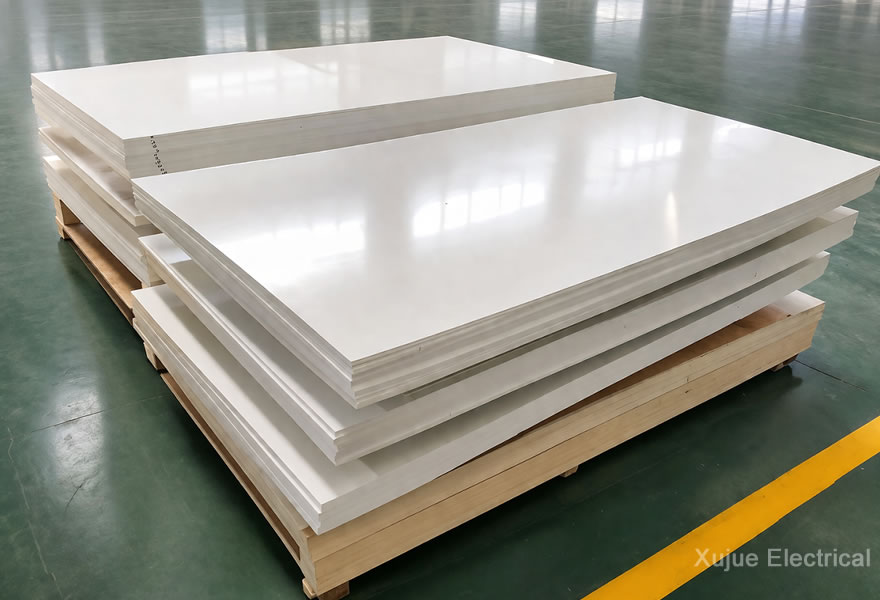
G7 silicone fiberglass laminate sheet, also known as H-class or G7-grade silicone fiberglass laminate, is a high-performance electrical insulation material made by impregnating electrical-grade alkali-free fiberglass cloth with silicone resin, followed by hot pressing and curing.
This type of laminate is known for its excellent heat resistance, dielectric properties, arc resistance, and dimensional stability. It is widely used for insulation and structural components in H-class motors, generators, electrical equipment, and other high-temperature applications.
To help engineers and purchasing teams select the appropriate material quickly and accurately, this guide summarizes the key properties, applications, and selection criteria for G7 silicone fiberglass laminate sheets.
1. Key Performance Specifications for Material Selection
When selecting G7 silicone fiberglass laminate, the following physical, electrical, thermal, and mechanical properties should be carefully evaluated according to the actual operating environment.
| Performance Category | Key Specification | Typical Value / Range | Selection Considerations |
|---|---|---|---|
| Thermal Class | Continuous operating temperature | 180°C (H-class) to 200°C (C-class), depending on the grade and applicable standard | Provides higher temperature resistance than many conventional epoxy-based laminates |
| Electrical Properties | Dielectric strength, perpendicular to laminate layers | Typically ≥12–15 kV/mm, depending on grade and test method | Important for insulation and dielectric breakdown protection in high-voltage applications |
| Electrical Properties | Insulation resistance after moisture conditioning | Typically ≥1.0 × 10⁸ Ω, depending on grade and test conditions | Important for insulation stability in humid environments |
| Mechanical Properties | Flexural strength at room temperature | Typically ≥150–200 MPa, depending on grade | Determines the material’s ability to withstand mechanical loads when used as a structural insulation component |
| Mechanical Properties | Flexural strength at elevated temperature | Generally retains a significant proportion of its room-temperature strength | Important when the laminate is exposed to continuous high-temperature mechanical stress |
| Flammability | Flame-retardant performance | Depends on the specific formulation and certification | Should be verified against the required UL94, railway, marine, or other applicable fire-safety requirements |
Note: Actual performance values vary according to the specific G7 grade, resin formulation, thickness, manufacturing process, and applicable test standard. Always refer to the manufacturer’s technical data sheet and test report before final material selection.
Basic Properties of G7 Silicone Fiberglass Laminate
G7 silicone fiberglass laminate is an electrical insulation laminate manufactured using silicone resin as the bonding system and alkali-free fiberglass cloth as the reinforcement. The material is formed through controlled hot-pressing and curing processes.
Its key advantage is the combination of high-temperature resistance, electrical insulation performance, mechanical strength, and dimensional stability.
Depending on the specific grade, G7 silicone fiberglass laminate can be designed for continuous operation at approximately 180°C or higher. It can also withstand short-term exposure to elevated temperatures while maintaining its structural integrity.
The material offers good dielectric performance and relatively low dielectric loss. In demanding electrical environments, it can provide stable insulation performance when the appropriate grade and thickness are selected.
Compared with conventional epoxy-based fiberglass laminates, silicone fiberglass laminates generally offer better performance in high-temperature and demanding environmental conditions. They can be suitable for applications involving humidity, outdoor exposure, and other challenging operating environments, provided the specific material grade meets the required requirements.
Major Applications in 2026
1. Railway Traction Motors
Traction motor insulation components are one of the important application areas for high-temperature silicone fiberglass laminates.
Railway traction systems require insulation materials with excellent thermal stability, dielectric strength, mechanical strength, and long-term reliability.
G7 silicone fiberglass laminate can be machined into various insulation and structural components for motors and electrical equipment.
2. High-Power Electrical and Power Electronics Equipment
High-power power supply systems and electrical equipment may require insulating support components capable of operating under elevated temperatures.
G7 silicone fiberglass laminate can be used for insulating supports, spacers, barriers, mounting components, and structural insulation parts, depending on the specific application.
3. Solar and Photovoltaic Equipment
Photovoltaic inverters and other outdoor electrical equipment require materials with good electrical insulation, temperature resistance, environmental stability, and, where required, flame-retardant performance.
G7 silicone fiberglass laminate can be considered for selected insulation and structural components in photovoltaic electrical systems.
4. Marine and Shipbuilding Equipment
Electrical equipment installed in ships may operate in environments characterized by high humidity, salt spray, and temperature fluctuations.
Silicone fiberglass laminate can be used for selected electrical insulation components where high-temperature and environmental resistance are required.
5. Industrial Furnaces and High-Temperature Equipment
Industrial furnaces and other high-temperature electrical equipment often require insulation materials capable of maintaining their electrical and mechanical properties at elevated temperatures.
G7 silicone fiberglass laminate can be used for insulating supports, spacers, structural components, and other customized electrical insulation parts, subject to the actual operating temperature and electrical requirements.
Key Performance Factors to Verify When Selecting G7 Laminate
1. Dimensional Accuracy and Thickness Tolerance
For precision electrical insulation components, dimensional accuracy is an important consideration.
The actual thickness tolerance of G7 laminate depends on the manufacturing grade, nominal thickness, production process, and applicable standard. For precision applications, customers should confirm the required thickness tolerance, flatness, length, width, and dimensional stability with the manufacturer before production.
If the material has excessive thickness variation or poor dimensional stability, additional machining or grinding may be required. This can increase CNC processing costs and affect the yield of finished components.
2. Electrical Insulation Performance
The dielectric strength and insulation resistance of the material should be evaluated according to the actual voltage, frequency, temperature, humidity, and insulation design requirements.
For high-voltage applications, it is important to verify the manufacturer’s test data and applicable standards rather than selecting a material based only on its G7 designation.
3. Flame-Retardant Performance
For applications involving fire-safety requirements, the exact flame-retardant rating should be confirmed.
Depending on the application and certification requirements, customers may need to verify compliance with UL94 or other applicable fire-safety standards.
This is particularly important for railway, marine, industrial electrical, and other safety-critical applications.
4. Mechanical Strength
Flexural strength, impact resistance, compressive strength, dimensional stability, and machinability should be considered when G7 laminate is used as a structural insulation component.
For CNC-machined parts, the material should also have sufficient mechanical integrity to prevent cracking, delamination, or dimensional deformation during machining and assembly.
Compliance and Certification Considerations
For international supply projects, customers should verify the applicable environmental, electrical, and quality requirements before placing an order.
RoHS and Environmental Compliance
For products supplied to the European market and other regulated markets, confirm whether the material complies with applicable RoHS and environmental requirements.
UL Certification
For applications in North America, customers may require materials with relevant UL recognition or certification. The specific UL file, material grade, thickness range, and intended application should be verified with the supplier.
IATF 16949
For automotive industry applications, suppliers with IATF 16949 quality management certification may be preferred, particularly when the material forms part of an automotive electrical or motor supply chain.
ISO Management Systems
For general industrial applications, customers may also evaluate the supplier’s:
- ISO 9001 – Quality Management System
- ISO 14001 – Environmental Management System
- ISO 45001 – Occupational Health and Safety Management System
These certifications can help customers evaluate the supplier’s quality-control processes, environmental management, and production management capabilities.
Looking for a G7 Silicone Fiberglass Laminate Manufacturer?
Xujue Electrical is a professional electrical insulation materials manufacturer with a history dating back to 1958.We provide G7 silicone fiberglass laminate sheets and customized electrical insulation solutions for customers in the transformer, motor, generator, power equipment, and industrial electrical sectors.
Xujue Electrical is an ISO 9001-certified manufacturer of electrical insulation materials. Our products are certified or tested to meet requirements such as UL, RoHS, and REACH. We also hold IATF 16949 certification for the automotive industry, demonstrating our commitment to consistent quality, reliable manufacturing, and industry-specific quality management standards.
If you are looking for G7 silicone fiberglass laminate sheet, G7 silicone fiberglass board, silicone glass laminate, or CNC-machined G7 insulation parts, please provide us with the following information:
G7 material specification
Length × width × thickness (mm)
Required quantity
Application
Operating temperature
Electrical insulation requirements
CNC machining drawings(if applicable)
Based on your application and technical requirements, Xujue Electrical can provide material selection support, sheet cutting, customized sizing, and CNC machining services for finished insulation components.
From raw material selection to cut-to-size sheets and precision-machined insulation parts, we aim to provide reliable and cost-effective electrical insulation material solutions for your project.
Contact Xujue Electrical for G7 silicone fiberglass laminate sheet and customized insulation solutions.
Leave us a message to get quotation and sample!
If you are interested in our products,, please send us a message and we will contact you as soon as we receive it. Email: info@ztaero.com whatsApp: +8616650273778
Releated News
- 09-14 2026G7 Silicone Fiberglass Laminate Sheet | Selection Guide & Manufacturer
- 09-11 2026Electrical Laminated Wood in Transformer Insulation Systems
- 09-09 2026Phenolic Laminated Sheets | Grades, Applications & CNC Machining
- 09-08 2026Epoxy fiberglass Sheet Weight Calculation Formula
- 09-07 2026FR4 Epoxy Sheet for CNC Machining: Thickness Selection & Purchasing Guide
- 09-03 2026Black Bakelite Sheet: Introduction & Sourcing Selection Guide