FR4 Epoxy Fiberglass Sheet: Non-Copper-Clad vs Copper-Clad
Discover the differences between non-copper-clad and copper-clad FR4 epoxy sheets, including applications in transformers, motors, switchgear, and PCB manufacturing.
Differences Between Non-Copper-Clad and Copper-Clad FR4 Epoxy Sheets
In the fields of electrical insulation, electronics manufacturing, PCB production, and industrial equipment, FR4 epoxy sheets are widely used as high-performance insulating materials. FR4 can be used either as an independent insulating sheet or as the base material for copper-clad laminates (CCL). Therefore, two common types of FR4 products are found in the market: non-copper-clad FR4 sheets and copper-clad FR4 laminates.
Although both products are primarily made from glass fiber fabric and epoxy resin, they differ significantly in structure, function, processing methods, and end-use applications. Understanding these differences can help users select the right FR4 material for their specific application.
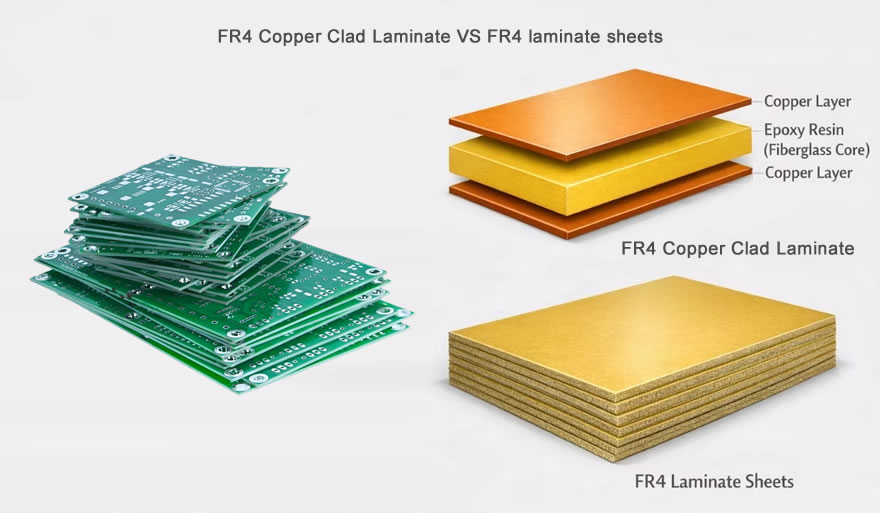
The Difference in One Sentence
Non-copper-clad FR4 = Insulating structural sheet
Copper-clad FR4 = FR4 substrate + copper foil = Material for PCB manufacturing
What Is a Non-Copper-Clad FR4 Epoxy Sheet?
A non-copper-clad FR4 epoxy sheet (FR4 Epoxy Fiberglass Sheet) is an FR4 laminate without copper foil on its surface. It is a high-performance glass-fiber-reinforced epoxy laminate manufactured using E-glass fiber fabric as the reinforcement and epoxy resin as the matrix. The manufacturing process typically involves resin impregnation, layering, and hot pressing under controlled temperature and pressure.
Its basic structure can be simply represented as:
Glass Fiber Fabric + Epoxy Resin → FR4 Epoxy Fiberglass Sheet
The surface of a non-copper-clad FR4 sheet is generally flat and electrically insulating, without a conductive copper foil layer.
The main functions of non-copper-clad FR4 are:
Electrical insulation + Mechanical support + Structural reinforcement
Therefore, it is commonly machined into various electrical insulation and structural components.
Typical Applications of Non-Copper-Clad FR4
Non-copper-clad FR4 is mainly used in electrical equipment and industrial insulation applications, including:
- Transformer insulation barriers
- Transformer insulation spacers
- Motor insulation components
- Generator insulation parts
- Switchgear insulation plates
- Electrical equipment support components
- CNC-machined insulation parts
- Electrical insulation structural components
For applications requiring a combination of good flame-retardant properties and excellent electrical insulation, non-copper-clad FR4 is a commonly used insulating material.
What Is Copper-Clad FR4?
Copper-clad FR4 (FR4 Copper Clad Laminate, FR4 CCL) is a composite material consisting of an FR4 epoxy fiberglass substrate laminated with a layer of copper foil on one or both sides.
A typical double-sided copper-clad FR4 structure can be represented as:
Copper Foil + FR4 Epoxy Fiberglass Substrate + Copper Foil
In this structure:
- Copper foil primarily provides electrical conductivity and serves as the conductive layer.
- FR4 substrate provides electrical insulation, mechanical support, and structural strength.
Copper-clad FR4 is an important base material used in the manufacture of printed circuit boards (PCBs).
Key Differences Between Non-Copper-Clad and Copper-Clad FR4
Although both products are based on FR4 materials, their different structures result in significant differences in their functions and applications.
| Comparison | Non-Copper-Clad FR4 | Copper-Clad FR4 |
|---|---|---|
| Product Name | FR4 Epoxy Fiberglass Sheet | FR4 Copper Clad Laminate |
| Copper Foil | None | Copper foil on one or both sides |
| Main Function | Insulation, mechanical support, structural reinforcement | Conductivity, insulation, and circuit support |
| Main Industries | Electrical insulation, industrial equipment | PCB manufacturing, electronics |
| Typical Customers | Transformer, motor, generator, and switchgear manufacturers | PCB manufacturers, electronic manufacturers |
| Common Processing Methods | CNC machining, cutting, drilling, punching | Etching, drilling, circuit pattern processing |
| Directly Used for PCB Manufacturing | Generally not used to manufacture PCB circuits | Yes, an important PCB base material |
| Typical Products | FR4 insulation sheets, insulation plates, spacers | FR4 CCL, copper-clad laminates |
Non-Copper-Clad FR4 for Electrical Insulation
For electrical equipment manufacturers, the main advantages of non-copper-clad FR4 are its excellent electrical insulation properties and high mechanical strength.
For example, in transformers, motors, generators, and switchgear, FR4 can be machined into insulation barriers, support components, spacers, end plates, and other structural parts.
In applications where components must withstand mechanical loads while maintaining reliable electrical isolation, FR4 can provide both:
Mechanical Support + Electrical Insulation
For this reason, non-copper-clad FR4 is an important material for electrical insulation and structural applications.
Copper-Clad FR4 for PCB Manufacturing
Copper-clad FR4 serves a different primary purpose.
The copper foil on a copper-clad laminate can be processed through photolithography and etching to form complex conductive circuits. Meanwhile, the FR4 substrate provides electrical insulation and mechanical support for the circuit layers.
Typical applications include:
- Printed circuit boards (PCBs)
- Industrial control boards
- Automotive electronics
- Communication equipment
- Power electronics
- Computers and servers
- Consumer electronics
- New energy vehicle electronics
Therefore, when a customer is looking for FR4 Copper Clad Laminate, their requirements are usually related to PCB manufacturing rather than traditional electrical insulation applications.
Why Are FR4 Products Often Confused?
The term FR4 generally describes a specific material system and performance classification, rather than one single finished product.
For example:
FR4 Epoxy Fiberglass Sheet
usually refers to a non-copper-clad FR4 epoxy fiberglass laminate used primarily for electrical insulation and structural applications.
While:
refers to an FR4 substrate with copper foil laminated onto one or both surfaces.
Therefore, simply specifying “FR4” is often not sufficient when purchasing FR4 materials.
Customers should clarify the following requirements:
- Whether copper cladding is required
- Single-sided or double-sided copper cladding
- Sheet thickness
- Copper foil thickness
- FR4 thermal class
- Flame-retardant requirements
- Electrical properties
- Mechanical properties
- Sheet dimensions
- Final application
Providing these details allows the supplier to recommend the appropriate FR4 material more accurately.
How to Choose Between Non-Copper-Clad and Copper-Clad FR4
The appropriate FR4 product depends primarily on the final application.
For Electrical Insulation Applications
For applications involving:
Transformers / Motors / Generators / Switchgear
the appropriate product is generally:
FR4 Epoxy Fiberglass Sheet
Key properties to consider include:
- Dielectric strength
- Insulation resistance
- Mechanical strength
- Thermal class
- Dimensional stability
- Water absorption
- Flame-retardant performance
For PCB Manufacturing
For applications involving:
PCB / Electronic Circuits / Printed Circuit Boards
the appropriate material is generally:
FR4 Copper Clad Laminate (CCL)
Key properties to consider include:
- Copper foil thickness
- Substrate thickness
- Dielectric properties
- Z-axis coefficient of thermal expansion (CTE)
- Peel strength
- Thermal stress performance
- Flame-retardant rating
Non-Copper-Clad FR4 and Copper-Clad FR4: Which Is Better?
It is important to understand that non-copper-clad FR4 and copper-clad FR4 are not simply a matter of which material has better performance.
They are designed for different purposes and applications.
Non-Copper-Clad FR4:
Primarily designed for electrical insulation, mechanical support, and structural reinforcement.
Copper-Clad FR4:
Primarily designed for conductive circuit formation, electrical insulation, and PCB manufacturing.
Therefore, non-copper-clad FR4 is generally more suitable for electrical insulation and structural components, while copper-clad FR4 is designed primarily for PCB manufacturing.
Although both products use the same or similar FR4-based material system, their final product positioning is quite different. For manufacturers of transformers, motors, generators, switchgear, and other electrical equipment, non-copper-clad FR4 epoxy fiberglass sheets are typically the more relevant product. For PCB and electronic manufacturing, FR4 copper-clad laminate (CCL) is the standard choice.
When purchasing FR4 materials, users should clearly specify the product structure and final application, and select the appropriate FR4 material according to the required mechanical, electrical, thermal, flame-retardant, and processing properties.
Leave us a message to get quotation and sample!
If you are interested in our products,, please send us a message and we will contact you as soon as we receive it. Email: info@ztaero.com whatsApp: +8616650273778
Releated News
- 10-13 2026How to Choose DDP Insulation Paper for Oil-Immersed Transformers?
- 10-12 2026FR4 Epoxy Fiberglass Sheets for CNC Machining Factories
- 10-10 2026Transformer Pressboard
- 10-09 2026Epoxy Fiberglass Filament-Wound Tubes for Transformer Core Winding Insulation
- 09-28 2026Transformer Kraft Paper vs. Thermally Upgraded Paper
- 09-28 2026Xujue Electrical Exhibits at Data Centre World Singapore 2026