Impact of Insulating Materials on Motor Performance
Insulating materials are not only the foundation of safe motor operation, but also have a direct impact on efficiency, reliability, service life, and noise performance.
Impact of Insulating Materials on Motor Performance
Motor Insulating materials are not only the foundation of safe motor operation, but also have a direct impact on efficiency, reliability, service life, and noise performance. In practical engineering applications, many motor performance issues are not caused by electromagnetic design, but are closely related to the selection and manufacturing quality of the insulation system.
The following sections systematically analyze the impact of insulating materials on motor performance from key technical perspectives.
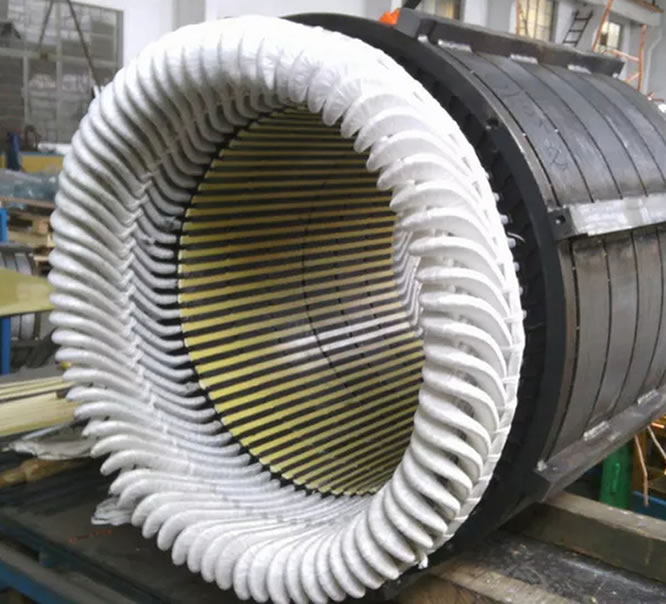
I. Impact on Motor Safety and Reliability (Core Influence)
Dielectric Strength and Insulation Margin
Insulating materials with insufficient dielectric strength can easily lead to: Insulation breakdown,Phase-to-phase short circuits,Ground faults。
High-quality insulation materials can effectively withstand:
Rated operating voltage
Surge voltage
Inverter PWM voltage stress
Result: Reduced failure rate and improved operational stability
Thermal Resistance and Aging Life
The service life of a motor is largely determined by the insulation life
For insulation systems, every 10°C increase in operating temperature reduces insulation life by approximately 50%
| Insulation Class | Max. Operating Temperature | Typical Applications |
|---|---|---|
| Class B | 130°C | Standard industrial motors |
| Class F | 155°C | High-efficiency motors |
| Class H | 180°C | High power density / inverter-fed motors |
👉 Higher thermal class = longer service life or higher power density design
II. Impact on Motor Efficiency and Losses
Dielectric Loss and Motor Efficiency
Insulation materials with a high dielectric loss factor (tan δ) cause: Additional heat generation,Reduced motor efficiency
This effect is more pronounced in high-frequency applications, such as:Variable frequency motors,Electric vehicle motors
Low dielectric loss insulation materials help improve efficiency and support high energy-efficiency classes (IE3 / IE4)
Influence on Heat Dissipation
Excessively thick insulation layers or materials with poor thermal conductivity:
Increase thermal resistance
Raise winding temperature
High thermal conductivity insulation materials:Facilitate faster heat transfer to the core and housing
Directly affects the continuous output capability and overload capacity of the motor
III. Impact on Structural Strength and Operational Stability
Mechanical Strength and Vibration Resistance
Insulating materials with insufficient mechanical strength may cause:
Winding displacement
Loosening of end windings
Increased partial discharge activity
Fiberglass-reinforced and mica-based composite materials significantly enhance vibration and impact resistance
Particularly critical for high-power and high-speed motors
Impregnation Performance and Overall Rigidity
Compatibility between insulation materials and impregnation varnish or epoxy resin affects:
Overall winding rigidity
Short-circuit withstand capability
VPI (Vacuum Pressure Impregnation) combined with a properly matched insulation system:
Reduces internal air gaps
Suppresses partial discharge
IV. Impact on Adaptability to Special Operating Conditions
Environmental Adaptability
Different operating environments impose specific requirements on insulation materials:
| Operating Condition | Insulation Requirements |
|---|---|
| High humidity | Low water absorption |
| Oil-immersed environment | Oil resistance and swelling resistance |
| Chemical exposure | Acid and alkali resistance |
| Outdoor operation | UV resistance and aging resistance |
Impact on Noise and Vibration
The damping characteristics of insulation materials affect:
Electromagnetic noise
Structural vibration
Proper material selection can reduce operating noise and improve comfort, especially in:
Electric vehicle motors
Elevator motors
V. Key Considerations for Different Motor Types
Industrial Motors
Focus on the balance between thermal class, cost, and reliability
Class F insulation systems are commonly used
High-Voltage Motors
Emphasis on dielectric strength and partial discharge resistance
Mica tape combined with epoxy resin systems
New Energy / Inverter-Fed Motors
Focus on resistance to partial discharge, high-frequency stress, and high dv/dt
Polyimide (PI) films and high-performance composite insulation materials
VI. Conclusion: How Insulating Materials “Define” Motor Performance
In one sentence:
Motor efficiency can be improved through design optimization, but service life, reliability, and performance limits are ultimately determined by the insulation system.
Core value of high-quality insulating materials:
✔ Enhanced safety
✔ Extended service life
✔ Support for high-efficiency and high power density designs
✔ Adaptation to complex operating conditions and advanced applications
Leave us a message to get quotation and sample!
If you are interested in our products,, please send us a message and we will contact you as soon as we receive it. Email: info@ztaero.com whatsApp: +8616650273778
Releated News
- 09-22 2026Xujue Electrical Exhibits at Enlit Asia 2026
- 09-22 2026High Voltage Motor Insulation Materials
- 09-20 2026Motor Insulation Materials: B, F, H & EV Motor Guide
- 09-17 2026Oil-Immersed Transformer Winding Insulation Paper
- 09-16 2026GPO-3 Fiberglass Mat Sheet | UPGM-203 Electrical Insulation
- 09-14 2026G7 Silicone Fiberglass Laminate Sheet | Selection Guide & Manufacturer