EPGC308 High-Tg Epoxy Glass Laminate sheet VS G11 sheet
EPGC308 is a high-performance epoxy glass laminate (IEC 60893) with H-class thermal resistance up to 180°C. Featuring high mechanical strength, low moisture absorption, and exce...
EPGC308 High-Performance Epoxy Glass Laminate
1. Overview
EPGC308 epoxy sheet is a high-performance epoxy glass fabric laminate defined under the IEC 60893 international standard. It is manufactured using electronic-grade, alkali-free woven glass fabric as reinforcement, impregnated with a modified high glass transition temperature (high-Tg) epoxy resin system, and cured under high temperature and high pressure.
Key positioning:EPGC308 is specifically engineered for structural and insulation applications requiring exceptional mechanical strength and dielectric stability in harsh environments such as high temperature, high voltage, and high humidity conditions.
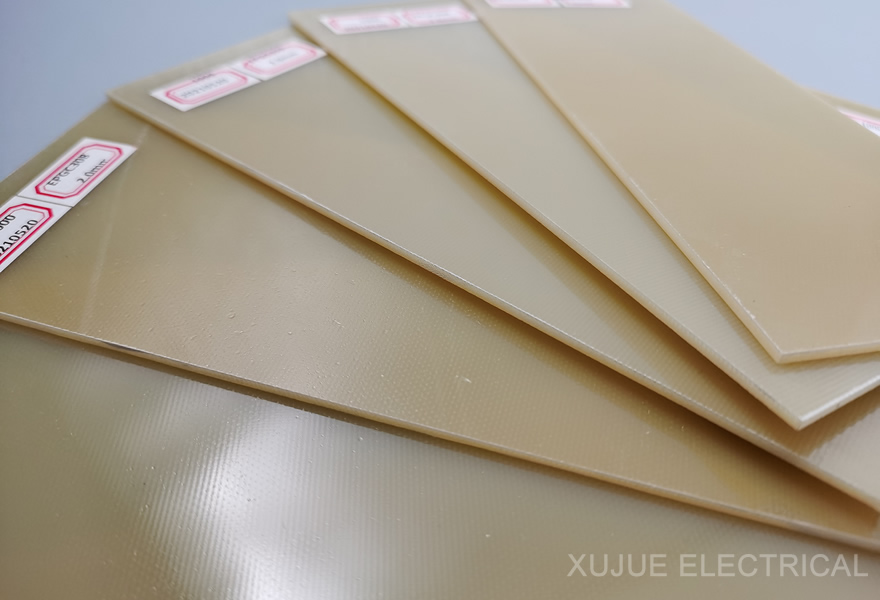
Appearance:Typically available in green, yellow, black with a smooth and flat surface finish.
Key performance:
Thermal Class: H (180°C)
Excellent arc resistance
Low moisture absorption
High mechanical strength retention at elevated temperatures
2. Manufacturing Process
The production of EPGC308 involves a controlled multi-stage thermoset lamination process combining physical impregnation and chemical cross-linking:
Glass Fabric + High-Tg Epoxy Resin → Impregnation → B-stage Prepreg → Lay-up → High-pressure Lamination → Post-processing
2.1 Resin Impregnation
A high-temperature-resistant epoxy resin system, curing agents, and flame-retardant additives are formulated into a resin bath. Alkali-free glass fabric is continuously passed through the bath, ensuring uniform resin penetration into fiber interstices.
2.2 B-Stage Curing (Drying Process)
The impregnated fabric is heated in a controlled oven to remove solvents and initiate partial polymer crosslinking. This results in a B-stage prepreg material that is dry to touch, stable for storage, and suitable for lamination.
2.3 Lamination & High-Pressure Curing
Multiple layers of prepreg are precisely stacked according to required thickness (typically 0.1 mm to 200 mm). The stack is then placed into a heated hydraulic press and cured under:
Temperature: >170°C
Pressure: multi-megapascal range
Duration: several hours
This process completes polymer crosslinking into a fully cured thermoset structure (C-stage).
2.4 Finishing & Quality Control
After cooling, the laminated boards undergo:
Edge trimming and surface finishing
Thickness tolerance inspection
Dielectric strength testing
Mechanical strength sampling
Final products are released only after passing full quality inspection.
3. Typical Applications
Due to its excellent high-temperature mechanical stability and dielectric performance, EPGC308 is widely used in critical electrical and power systems:
High Voltage Motors & Generators
Slot wedges
Winding spacers
Carbon brush holders
End-winding insulation components
Transformer Industry
Support bars and spacer blocks
Insulating cylinders
Clamping structure insulation
End rings for oil-immersed and dry-type transformers
Switchgear & Circuit Breakers
Phase barriers
Arc chute structural parts
Safety shields
Actuation insulation components
Renewable Energy & Electronics
Photovoltaic inverters
Wind power systems
High-temperature test fixtures for PCB and semiconductor applications
4. EPGC308 vs G11 (Key Technical Differences)
Although often confused in the market, G11 is a general designation under NEMA standards, while EPGC308 is a precise IEC classification with higher thermal performance.
| Property | EPGC308 (IEC 60893) | Standard G11 (e.g. EPGC203) |
|---|---|---|
| Standard System | IEC 60893 | NEMA LI-1 / IEC equivalent |
| Thermal Class | H-Class | F-Class |
| Max Operating Temperature | 180°C (short-term up to 200°C) | 155°C |
| Mechanical Strength at High Temp | >70% retention at 150–180°C | Significant drop above 150°C |
| Resin System | High-Tg epoxy (>200°C Tg) | Standard epoxy (Tg ~150–170°C) |
| Market Naming | Often called “High-Tg G11” or “G11-H” | Standard G11 |
Leave us a message to get quotation and sample!
If you are interested in our products,, please send us a message and we will contact you as soon as we receive it. Email: info@ztaero.com whatsApp: +8616650273778
Releated News
- 10-13 2026How to Choose DDP Insulation Paper for Oil-Immersed Transformers?
- 10-12 2026FR4 Epoxy Fiberglass Sheets for CNC Machining Factories
- 10-10 2026Transformer Pressboard
- 10-09 2026Epoxy Fiberglass Filament-Wound Tubes for Transformer Core Winding Insulation
- 09-28 2026Transformer Kraft Paper vs. Thermally Upgraded Paper
- 09-28 2026Xujue Electrical Exhibits at Data Centre World Singapore 2026